
11 November 2026
Notes from the interview room
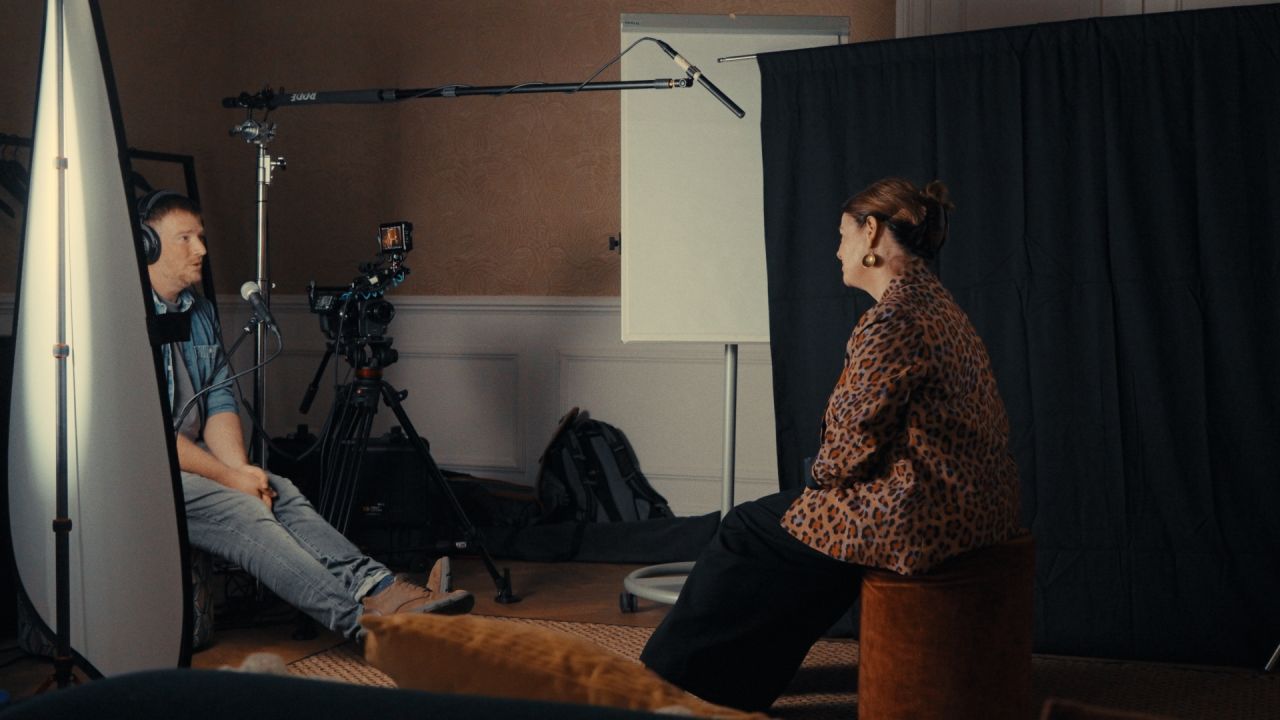
In October I spent four days in one room at Tour & Taxis in Brussels. Outside that room the first Brussels Climate Week was going on, with corporate sustainability leads, policymakers, scientists and activists all in one hall. Inside it, nineteen of them sat down across from me, one after the other, and I asked them why they do this work.
Why I said yes
I took this job out of a conviction. I believe that the way we communicate about climate is at least as important as the actual work.
We do know a lot. There was plenty of data on the stages that week, as there is at every conference of this kind. Unfortunately, knowing has never been enough to get us humans moving. Climate change plays out over decades, and that makes it very hard to feel. I studied energy and environmental management, I worked in renewable energy research, and I still find it hard to feel on an ordinary Tuesday.
What does get through to me is a person. Someone I can relate to, whose shoes I can step into for ninety seconds. I feel what they are up against, I feel what keeps them going, and I see that there is a way out, because this person is already working on it. The solutions are there for the rest of us to step into as well. We can engage with them, invest in them, collaborate with the people behind them, or start our own version somewhere else.
That is what I think effective climate communication comes down to, and it is what we set out to do in Brussels.
How the conversations went
I have to admit that I had not read up on most of them. With most of the nineteen, we met for the first time as they sat down. So I started every conversation with the person. Where they grew up. The first time climate change got their attention. Whether they remember a moment when they knew this was something they wanted to take on in their life. What it would mean to them if it carries on the way it's going. How they got into their profession, and what sparked their interest in the solution they are working on now.
Only after all of that did we talk about the work itself, and by then you already know why it matters to them.
Three conversations that stayed with me
I have to start with Sandrine Dixson-Declève. I heard her speak for the first time a few years ago at the B for Good Leaders Summit in Amsterdam, and each time she speaks, she completely rocks. I have been a fan of the Club of Rome for a long time, and she has been its co-president for many years. I simply agree with what they stand for. That there are limits to growth. That we cannot expect a few percent of growth every year, because then we end up with an exponential curve, and that is just not possible. That we need to start living with nature and its resources, and stop treating decoupling as the only way out. So you can imagine how amazed I was to sit down across from her.
Then there was Martin Hojsík, Vice-President of the European Parliament. He told me how he grew up as an activist, upset by the pollution in his home country. People told him he could simply help clean up and pick up the trash, and he refused. He said no, he wanted to put fire under the asses of those who pollute in the first place, and stop them from doing so. That resonated with me. He went on to talk about the campaigns he did with Greenpeace, and I was delighted to hear that his mindset is still very much that of an activist, only now from a place of power in the European Parliament. His ninety seconds are on the case study page.
The conversation that had the biggest impact on me was with Katharina Beumelburg. She told me about having the privilege of flying by helicopter to an ice shelf in the Arctic. While she was there, a part of the shelf the size of Munich broke off. Very slowly, with a rolling thunder, and then it drifted away. She returned home feeling that she had to find a way to dedicate her work, her career, to solving this. It had a big impact on her, and it had a big impact on me, sitting there listening to it.
I am a filmmaker, and I know I won't solve the climate crisis from an interview room. However, I do believe story belongs in the box of tools, and a few days with all these people in one hall is a very good place to start using it. What we made in that room, and how the week was set up, is on the case study.