
16 april 2026
The Story Atlas: Why Your Organization Is Sitting on a Content Gold Mine
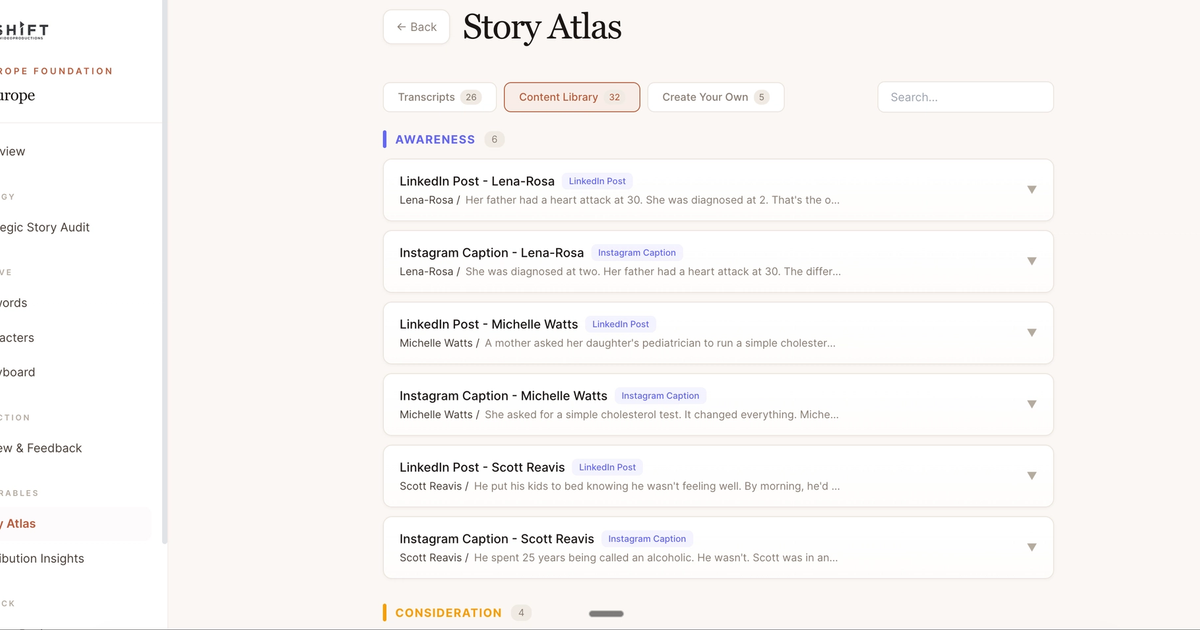
Most mission-driven organizations waste their best stories during the research phase. Here's how to capture and use the human voices that don't make it into your main content but could power your communication all year long.
Every documentary filmmaker knows this frustration. You interview ten people for a project, but only three make it into the final film. The other seven conversations? They sit in a folder somewhere, full of powerful stories that nobody will ever hear.
I used to think this was just part of the process. The cost of finding the right characters for a story.
But recently, I realized something. Those unused interviews aren't waste. They're a content gold mine.
The Problem Most Organizations Face
Mission-driven organizations struggle with the same communication challenge over and over. They fall back on facts, statistics, and abstract arguments about their impact.
Their newsletters read like reports. Their social media posts sound institutional. Their fundraising materials feel distant from the actual people they serve.
It's not because they don't have good stories. It's because they don't have a system to capture and organize those stories.
What I Call the Story Atlas
When I'm researching characters for a documentary, I have conversations with five to ten potential people before filming begins. These are deep, exploratory calls where people share their experiences, their motivations, their moments of change.
Not everyone becomes a main character in the film. But everyone shares something valuable.
So I started creating what I call a Story Atlas for my clients. It's a organized library of all those conversation transcripts, turned into usable content.
Instead of just delivering a finished film, I give organizations access to the actual words of the people their work impacts. Quote libraries. Story snippets. Human moments they can weave into their ongoing communication.
How This Changes Everything
Imagine you're writing your monthly newsletter. Instead of starting with "Our program served 150 families this year," you can start with Maria's actual words about the moment she realized she could provide for her children again.
Instead of saying "We believe in community-driven solutions," you can share James describing how his neighbors showed up when his family needed help most.
The difference isn't just stylistic. It's neurological. Stories activate different parts of the brain than facts do. They create empathy, not just understanding.
Building Your Own Story Atlas
You don't need a documentary filmmaker to start capturing stories. You need intention and a simple system.
Start with the conversations you're already having. Client check-ins. Staff meetings. Community events. Volunteer orientations.
Ask one additional question: "Can you tell me about a specific moment when you realized this work mattered?"
Record the answer. Transcribe it. Highlight the most powerful phrases.
Over time, you'll build a library of authentic voices. Real people describing real impact in their own words.
The Long-Term Payoff
Most organizations communicate reactively. They scramble for content every quarter, starting from scratch every time.
A Story Atlas changes that dynamic. Instead of asking "What should we say?" you start asking "Whose voice should we amplify?"
Your communication becomes more coherent because it's rooted in consistent human truth. More trustworthy because audiences hear real people, not polished messaging. More resonant because emotion drives action, not information.
The stories are already there, waiting in your organization. In the lives of the people you serve, the staff who believe in the mission, the volunteers who show up week after week.
The question is: are you capturing them?